
Boressa Republic
Also known as Boressa
The Boressa Republic (Boressan: Republika Boressa), commonly known as Boressa, is a country consisting of a large continental mainland and a major island to its north, separated by the Torton Narrows and the Kalford Strait. It covers an area of some 439,000 square kilometres and, with 6.9 million inhabitants, remains one of the more sparsely populated countries in its region. Boressa shares land borders with Valeria to the west and Orania to the east, faces the Darwell Sea to the south and The Northstand to the north, and is divided into sixteen provinces. Its capital and largest city is Boregrad.
Around ninety percent of Boressan territory is forested, and most of the population is concentrated in a small number of cities along the country's road corridors. Following two decades of sustained, infrastructure-led growth, Boressa is classified as an upper-middle-income economy. It is noted internationally for the unusual structure of its transport system: virtually all land freight moves by road on a heavily tolled national highway grid, the small railway network is by law restricted to passenger traffic, and domestic aviation operates on a fully commercial, unsubsidised basis. The country's chronically sold-out internal flights and its dense expressway interchanges have become fixtures of Boressan popular culture.
Etymology
The name Boressa is generally derived from the Old Borean root bor-, meaning "pine" or "pine forest", a reference to the vast coniferous belts of the interior; the suffix -essa is a common Old Borean territorial ending. The same root appears in the name of the capital, Boregrad ("pine city"), and in the ethnonym Borean. A minority of philologists have instead linked the name to boras, a north wind in Valerian maritime dialects, though this view has little currency in modern scholarship.
History
Pre-integration period
Before the mid-twentieth century, the territory of modern Boressa was a patchwork of coastal mercantile city-states, inland mining and timber districts, and highland communities with limited contact between them. The Valerian ports of the Darwell coast conducted most of the region's external trade, while the Borean interior remained economically isolated behind mountain ranges and dense forest. The deep waters of the Torton Narrows and the Kalford Strait kept the northern island — historically known as the Yor country — politically and commercially separate from the mainland. Contemporary observers described the region as "rich in everything except roads."
Integration and the Natien era
The modern republic was established by the Articles of Integration, ratified on 11 March 1949 and drafted largely by Kaelen Q. Natien, an industrialist and political writer who had spent two decades campaigning for economic union. Natien's coalition dissolved internal tariffs, centralised fiscal authority in Boregrad, and committed the new federal government to a single overriding priority: the construction of a unified national road network. The ensuing programme, remembered as the Great Integration, ran for roughly three decades and connected the western timber towns, of which Croridge is the best-known example, to the eastern trading hubs around Kalham Bridge. Natien served as the republic's first president until 1961 and remains the dominant figure of Boressan national memory; the country's principal airport, several universities, and the main hall of the National Assembly bear his name.
The Great Integration also fixed the two structural peculiarities that still define Boressan transport policy. First, because road-building had absorbed nearly all early capital, the republic never developed a freight railway; when a national railway was eventually proposed, the trucking industry — by then the country's largest employer — successfully lobbied for a constitutional-rank statute (the Carriage Act of 1974) reserving rail for passenger use. Second, the decision to bridge the island–mainland divide with ferries and, later, aircraft rather than a fixed link entrenched a large domestic aviation market unusual for a country of Boressa's size.
The National Mobility Programme (2008–present)
By the early 2000s the ageing Integration-era network had become a brake on growth, and the country was losing population: between 2008 and 2017 the population fell from 6.23 million to a low of 5.54 million, driven by rural decline and sustained emigration of working-age Boressans to neighbouring economies. In response, the government of the day launched the National Mobility Programme (NMP) in 2008, a rolling, debt-financed reconstruction of the entire transport grid.
Landmark dates of the NMP period include the opening of the Croford–Kalbury vehicle ferry across the Torton Narrows in July 2008, restoring a reliable surface link to the northern island; the inauguration of the country's first scheduled commercial air service, from Boregrad to Ithmere Grove, in January 2010; and the completion of the Capital Line railway between Boregrad and Gilden in 2019, the republic's first passenger rail service. In 2018 Boregrad became the first Boressan city to pass one million inhabitants.
The programme is widely credited with reversing the demographic slide. Net emigration turned to net return migration around 2015, and by 2026 the population had recovered to 6.87 million, its highest level in the republic's history. Gross domestic product grew more than fourfold over the same period, and in 2024 per-capita income crossed the $10,000 threshold, moving Boressa into the World Development Council's upper-middle-income band — an event marked by a national holiday. The NMP's legacy is contested, however: it left the state transport authority carrying approximately $24.6 billion in long-term debt, equivalent to about 28 percent of GDP, and critics argue that its road-first orientation has locked the country into a high-cost logistics model.
Geography
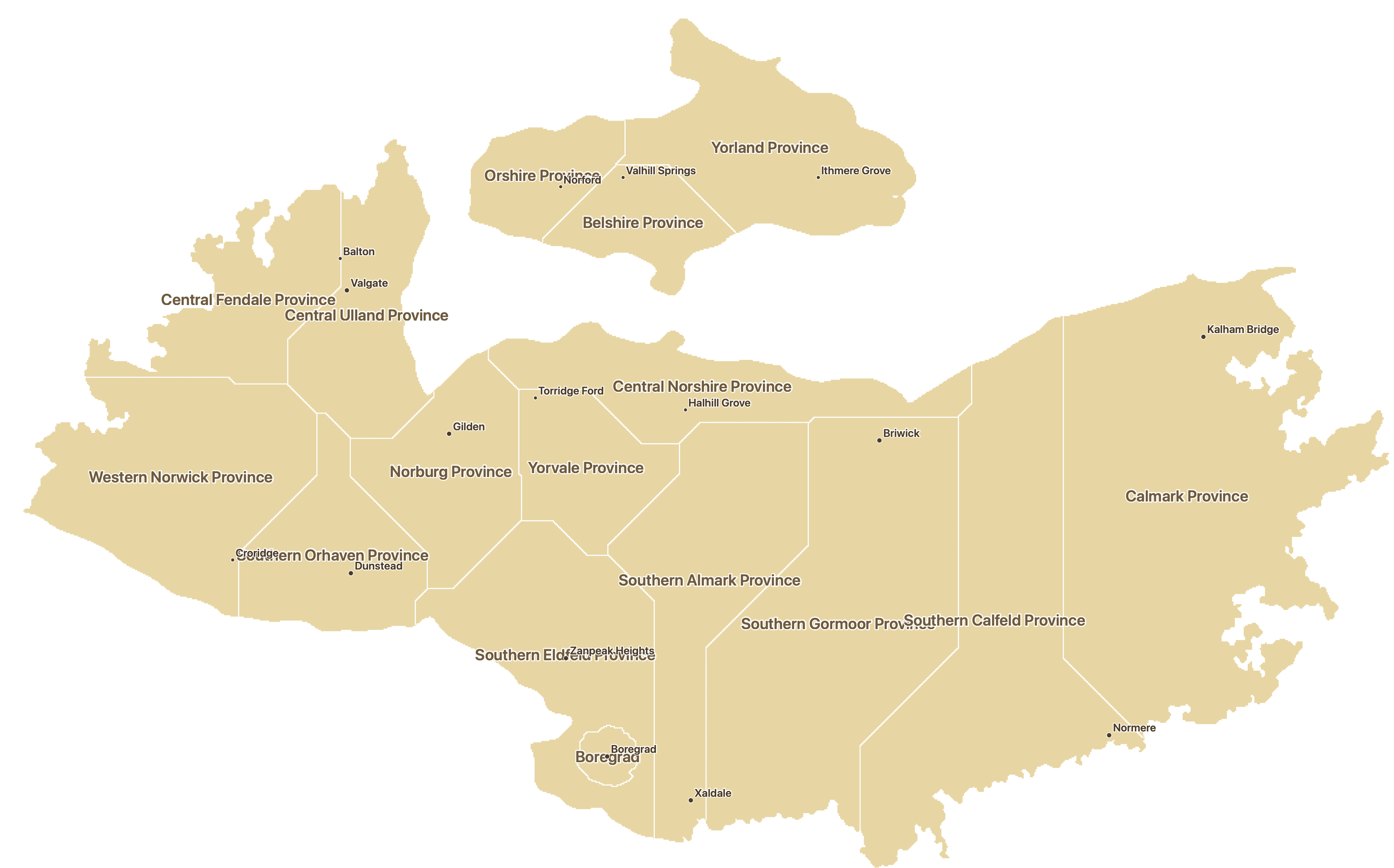
Boressa spans 438,714 square kilometres across two principal landmasses. The mainland, comprising about four-fifths of the national territory, stretches from the Darwell Sea coast in the south — where the capital, Boregrad, stands — to the shores of the Torton Narrows in the north, and from the Valerian border in the west to the Torvane Fells on the Oranian frontier in the east, where the country reaches its highest point, Mount Torvane (2,580 m). In the northwest, the mainland extends into the long Ulland Peninsula, whose eastern tip at Croford approaches to within forty kilometres of the northern island; the peninsula shelters the cities of Valgate, Garwell Ford and Balton and encloses the western entrance of the Narrows. The northern island, washed by The Northstand, comprises three provinces: Orshire in the west, facing the peninsula across the mouth of the Narrows; Belshire on the south coast, fronting the Kalford Strait; and Yorland in the east, whose shores enclose Kalford Bay.
The coastline is deeply indented. Kalford Bay in the northeast and the broad, unnamed gulf south of the Torton Narrows — known informally as the Norburg Bight — form the largest sheltered waters and support most of the country's harbour towns, among them Ulpeak Harbour, Falpeak Harbour and Zanham Bay. Three upland systems cross the territory in a scattered pattern: the Torvane Fells in the east, the Norwick Uplands around Havwood and Havridge in the far west, and a belt of lower hills in the southern interior. Between them, the central plains have historically channelled settlement and, in the modern era, the highway network. Roughly ninety percent of the country is forested — the highest share among its neighbours — and the river system is dense, though few rivers are navigable for commercial traffic.
The climate is cool-temperate and strongly continental in the interior, with long snowy winters on the northern island and in the Fells; the Darwell coast is milder and wetter. Winter road maintenance is a significant and politically sensitive item of public expenditure.
Government and politics
Boressa is a unitary constitutional republic with a directly elected executive president and a strong technocratic administrative tradition dating to the Natien era. The incumbent head of state and government is President Aris Thorne, first elected in 2021 and re-elected in 2025 on a platform of digitalising the national transit grid.
Legislative power rests with the bicameral National Assembly in Boregrad. The upper house, the Senate, seats three senators from each of the sixteen provinces regardless of population, a design intended to check the political weight of the capital; the Chamber of Deputies is apportioned by population and consequently dominated by members from the Boregrad, Southern Calfeld and Norburg delegations.
Party politics has been organised since the late 1990s around a durable two-bloc system. The governing National Development Alliance (NDA), a centrist pro-industry formation, has held the presidency for four consecutive terms; it is closely identified with the National Mobility Programme and is the principal defender of the passenger-only railway mandate. The main opposition, the Liberal Trade Front (LTF), campaigns for repeal of the Carriage Act of 1974 to permit rail freight, arguing that the highway grid is approaching saturation and that road tolls function as a hidden tax on consumers. The freight question is the closest thing Boressan politics has to a permanent cleavage; every general election since 2013 has been fought substantially over it.
Administrative divisions
Boressa comprises sixteen provinces, of which the Boregrad Special City was separated from surrounding Southern Eldfeld in 1971. Each province has an elected council and a governor, though fiscal autonomy is limited and most infrastructure spending is federal.
| Province | Capital | Population (2026) |
|---|---|---|
| Boregrad Special City | Boregrad | 1,794,050 |
| Central Ulland | Valgate | 1,459,869 |
| Norburg | Gilden | 1,191,774 |
| Southern Calfeld | Normere | 1,115,356 |
| Calmark | Kalham Bridge | 334,941 |
| Southern Eldfeld | Zanpeak Heights | 185,770 |
| Southern Almark | Xaldale | 162,969 |
| Southern Orhaven | Dunstead | 150,499 |
| Yorland | Ithmere Grove | 147,417 |
| Belshire | Valhill Springs | 89,223 |
| Southern Gormoor | Briwick | 86,934 |
| Central Norshire | Halhill Grove | 36,280 |
| Orshire | Norford | 33,677 |
| Central Fendale | Balton | 32,246 |
| Western Norwick | Croridge | 32,465 |
| Yorvale | Torridge Ford | 15,838 |
Economy
Boressa is an upper-middle-income economy with an estimated nominal GDP of $86.7 billion in 2026, or $12,622 per capita. Growth during the National Mobility Programme era has been exceptionally rapid — averaging roughly 15 percent annually in nominal terms over the decade to 2025, among the fastest sustained expansions recorded in the region — though the pace has moderated markedly in 2026 as the programme's largest projects reach completion. Economists attribute the boom principally to the collapse in internal transport costs: districts that were two days' haul from a port in 2005 are now within a single driving shift of one, and formerly isolated rural markets have been drawn into national supply chains.
The economy is strongly domestically oriented. Logistics and road haulage form its backbone — approximately 88 million tonnes of freight moved by road in 2025, representing the entirety of the country's land freight task — followed by timber and wood products, machinery, and food processing. Heavy manufacturing is dispersed across the central plains in cities such as Torridge Ford and Halhill Grove, while finance, technology and public administration are concentrated in Boregrad, whose metropolitan economy of some $43 billion accounts for roughly half of national output. Normere, the second city, is the traditional centre of the timber and paper industries.
Public finances are dominated by the transport account. The federal transport authority carries seven long-term loans totalling about $24.6 billion outstanding, contracted at five to six percent over thirty-year terms, secured against the toll-earning road network itself; debt service is met primarily from tolls, which apply to about 86 percent of the highway system, and from the universal aviation surcharge. The arrangement — infrastructure debt serviced by user charges rather than general taxation — is regarded as fiscally orthodox by the ruling NDA and as regressive by the opposition. The authority also maintains a statutory reserve, the Transport Fund, with a balance of approximately $1.4 billion.
Transport
Transport in Boressa is organised around a strict modal specialisation that has no close parallel elsewhere: roads carry all freight and the great majority of passengers, the railway carries commuters only, aviation bridges the island–mainland divide, and a single ferry corridor carries vehicles across the Torton Narrows. Traffic drives on the right.
Roads
The national highway grid extends 11,733 kilometres and is the largest single public asset in the country. It carried an estimated 330 million passenger journeys and 88 million tonnes of freight in 2025. Roads are classified into five grades under the National Road Code: E-class expressways (649 km, posted at 140 km/h, six lanes on the busiest sections), R-class regional trunk roads (1,948 km, 80 km/h), N-class national roads (5,104 km, 60 km/h), and P-class provincial and L-class local roads making up the remainder. The two flagship expressways — the E1 Boregrad Orbital and the E2 Boregrad–Gilden Corridor — are engineered with grade-separated freight connectors throughout their urban sections to keep long-haul trucks out of city traffic, a design that has been studied by road authorities abroad.
Tolling is near-universal on the trunk network and is collected electronically. Toll rates are set by the transport authority on a cost-recovery formula and are a recurrent subject of political controversy, particularly in the freight sector.
Aviation
Because no fixed link crosses the Kalford Strait, domestic aviation carries a share of intercity travel that is unusual for a country of Boressa's population. Seven airports handle scheduled services — Boregrad–Natien International (BRG), Normere (NRM), Gilden (GLD), Valgate (VLG), Garwell Ford (GRW), Valhill Springs (VLH) and Ithmere Grove (THM) — connected by nine domestic routes numbered BO-001 to BO-009, which together carried about 1.4 million passengers in 2025.
Boressan aviation policy is doctrinally commercial: no route receives any operating subsidy, and a flat surcharge of $35 is levied on every passenger ticket toward the transport authority's debt service. Fares are otherwise unregulated, and because capacity is added conservatively, virtually every scheduled flight in the country departs full — a fact so notorious that "getting a Tuesday seat" is a Boressan idiom for good luck. The busiest route by frequency is the island shuttle between Valhill Springs and Valgate, with up to seven round trips daily; the oldest is the 2010 Boregrad–Ithmere Grove trunk route; the newest, Boregrad–Garwell Ford, opened in February 2026. The Liberal Trade Front has repeatedly proposed allowing subsidised "essential service" flights to smaller towns, a measure the government has rejected as inconsistent with the commercial mandate.
Railways
The national railway comprises a single 327-kilometre passenger corridor, the Capital Line, opened in stages in 2019 and operated as a commercial commuter service. The line runs from Central Station in Boregrad — a monumental concrete-and-glass terminus that has become an emblem of the capital — north through Zanpeak Heights and Olwood Haven to Gilden, with eight return services daily worked by eight-car electric sets. Ridership has grown steadily and reached approximately 4.7 million passengers in 2025, and the service turned an operating profit for the first time in 2024. Under the Carriage Act of 1974 the network may not carry freight of any kind; proposals to extend the line north toward Valgate and to build a second corridor along the Darwell coast are under review.
Ferries and ports
Surface connection between the mainland and the northern island is provided by the Croford–Kalbury ferry, a 35-kilometre roll-on/roll-off corridor across the western mouth of the Torton Narrows, linking Croford at the tip of the Ulland Peninsula, near Garwell Ford, with Kalbury on the Orshire headland opposite. Opened in July 2008, the service operates up to seventeen sailings daily and functions in law as a floating segment of the N-road network; each vessel carries up to 500 passengers together with laden trucks. A second corridor across the Kalford Strait, between Gilmere on the Central Norshire coast and Kalford Heights in Belshire, operated between 2008 and the mid-2010s but was suspended as air capacity expanded, although both port facilities are maintained in reserve. The republic's four commercial ports — Gilmere, Kalford Heights, Croford and Kalbury — are modest by international standards but rank among the leading roll-on/roll-off hubs of the region relative to traffic.
Demographics
Boressa recorded an estimated population of 6,869,308 in 2026. The country's recent demographic history is defined by a pronounced decline-and-recovery cycle: the population fell by roughly 690,000 between 2008 and 2017 under the combined pressure of rural depopulation and emigration, then regained the entire loss within nine years as the economy accelerated, aided by returning emigrants and, since 2020, modest net immigration from Valeria and Orania. Boressa is now among the most urbanised countries in its region; the thirteen smallest of its ninety-one officially designated settlements have fewer than two thousand inhabitants each, and several are the subject of managed-consolidation programmes.
Two conurbations hold official metropolitan status: the Boregrad Metropolitan Area, with 1.67 million residents, and the Gilden Metropolitan Area in Norburg Province, with 893,000. Normere, though larger than Gilden as a municipality, has declined to seek metropolitan designation, which carries planning obligations that its council has historically opposed.
| Rank | City | Province | Population (2026) |
|---|---|---|---|
| 1 | Boregrad (Capital city) | Boregrad | 1,670,129 |
| 2 | Normere | Southern Calfeld | 1,086,477 |
| 3 | Gilden | Norburg | 893,004 |
| 4 | Valgate | Central Ulland | 696,544 |
| 5 | Garwell Ford | Central Ulland | 666,742 |
| 6 | Kalham Bridge | Calmark | 225,786 |
| 7 | Ulpeak Harbour | Norburg | 157,586 |
| 8 | Dunstead | Southern Orhaven | 135,738 |
| 9 | Xaldale | Southern Almark | 135,173 |
| 10 | Zanwick Springs | Norburg | 89,105 |
The population comprises three historic communities: the Boreans of the interior plains, who form the large majority; the Valerians of the Darwell coast, descendants of the pre-integration maritime states, whose kin form the majority in neighbouring Valeria; and the Oranians of the eastern highlands, culturally linked to Orania across the Torvane Fells. A century of internal migration along the road network has produced a high degree of cultural convergence, and interethnic marriage rates are among the highest recorded in the region. Boressan, a standardised form of the central Borean dialects, is the sole official language; Valerian and Oranian enjoy protected regional status in six provinces.
Culture
Boressan culture is saturated with the imagery of movement. The republic's founding narrative is a story about roads, its national holiday (Integration Day, 11 March) is marked by convoy parades, and the school civics curriculum still opens with Natien's aphorism that "a nation is the sum of its connections." Long-distance driving occupies the place in Boressan life that seafaring or ranching holds in other national mythologies: trucker ballads are a recognised popular-music genre, and the annual Trans-Boressa Rally along the E2 corridor is the country's largest sporting event.
Everyday life in the major cities runs to the rhythm of the transport system — the Capital Line timetable, the morning toll-gate reports, and the perpetually overbooked island flights, whose scarcity has generated a folklore of its own. Boressan architecture favours grand functionalism, exemplified by Central Station's parabolic concrete vaults and the multi-level interchanges of the Boregrad Orbital, several of which are protected as national monuments. Cuisine reflects the forested geography — game, river fish, pine honey and preserved berries — while the coastal Valerian provinces maintain a distinct maritime table. The national dish, borka, is a smoked-fish and barley stew traditionally associated with long-haul drivers' waystations.
Was this article useful? Sign in to leave feedback.